Malaysian Original · Food, family and invention

Mamee Monster: The Malaysian Snack Born from an Observation

Ayer Keroh, Melaka

How a small Melaka noodle factory noticed Malaysians eating instant noodles dry—and turned that behaviour into a home-grown snack remembered across generations.

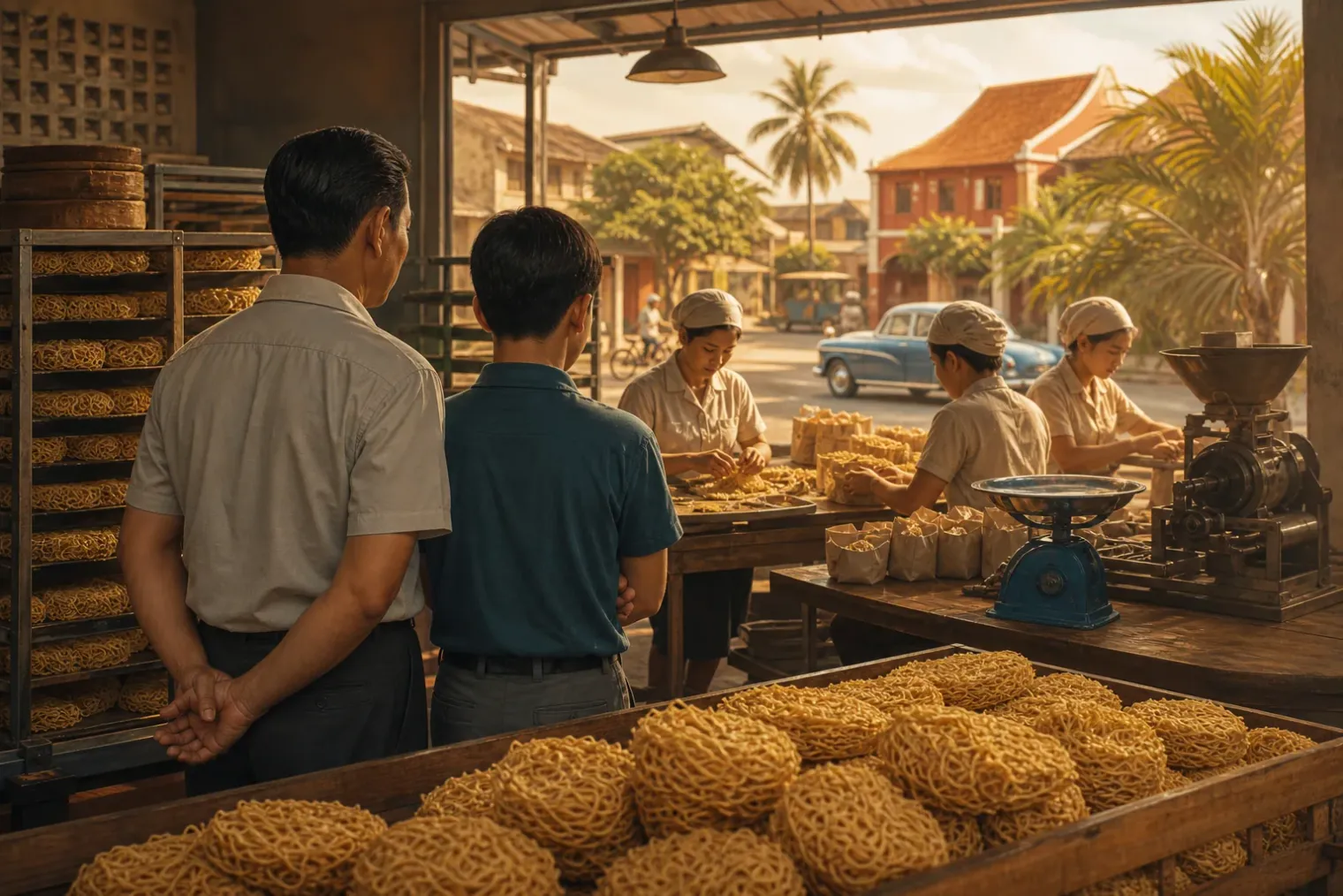
AI-generated editorial interpretation of a 1970s Melaka noodle factory where a father and son notice people eating dry noodles
AI-generated editorial visual · not documentary photography

Documented story · Origin anecdote is clearly attributed

1974Crunchy noodle snack launched

01 · The opening scene

The noodles were not selling. The snack was already happening.

In the early 1970s, a small factory in Melaka made an instant noodle called Lucky. Malaysians could boil it into a meal, but the product did not immediately become the success its founders needed.

Then came an observation that the family still tells. People were eating the noodles without cooking them—breaking the dry block into crunchy pieces and adding the seasoning from the packet. Accounts differ on whether the decisive scene involved rubber tappers, workers or villagers, but the behaviour itself pointed towards a different product.

Instead of insisting that customers use the noodle as intended, the business listened. In 1974 it launched a seasoned dry-noodle snack made to be crushed, shaken and eaten from the bag. Mamee Monster had found its form.

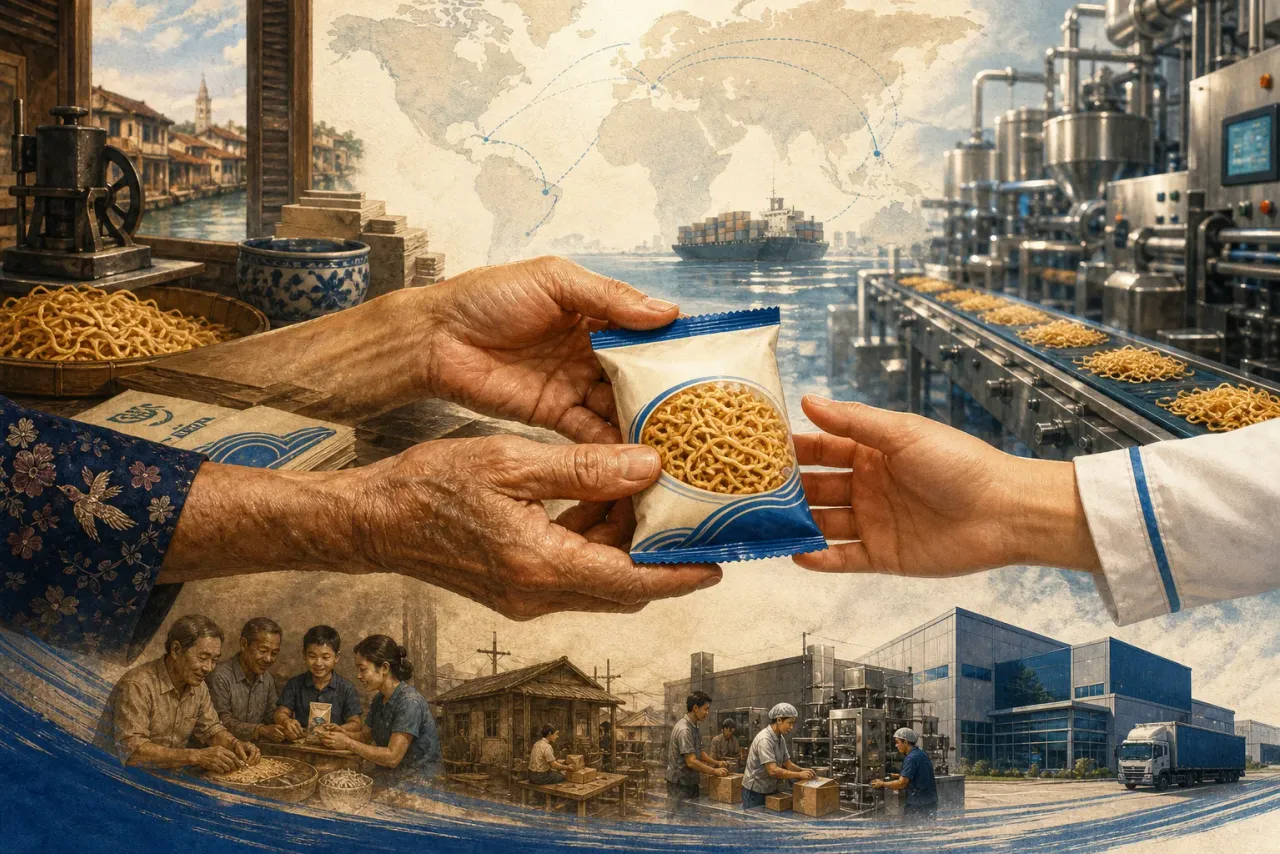
AI-generated editorial interpretation of a multigenerational Malaysian snack business growing from a small factory to wider markets
AI-generated editorial visual · not documentary photography
Started
A small noodle factory in Melaka, 1971
First product
Lucky instant noodles, 1972
The pivot
A crunchy noodle snack, 1974
Built
A multigenerational Malaysian food company
02

Before the monster

A founder traded used cars for a factory.

Pang Chin Hin was already an entrepreneur before food manufacturing. Malaysian reports describe him as a used-car dealer who, with a partner, opened Pacific Food Products in Melaka in 1971. The business entered a young Malaysian instant-noodle market with limited capital and no guarantee that shoppers would choose its unfamiliar brand.

Lucky instant noodles followed in 1972. MAMEE's official history says the response was lukewarm. That early disappointment matters because the company's most enduring idea did not arrive as a perfect founding vision. It came from being willing to reconsider what the factory was actually good at making.

The family account places founder Pang Chin Hin and his son, Pang Tee Chew, at the centre of the pivot. One generation had built the production base; the next helped notice that the product's texture could matter more than the meal it was supposed to become.

The breakthrough was not a new ingredient. It was noticing that customers had already invented a new use.
03

The useful observation

Crush, season, shake: a product becomes a ritual.

Mamee Monster formalised what people were doing informally. The noodle block could be crushed inside the packet, mixed with seasoning and eaten by hand. Preparation became play, and the package became both container and mixing bowl.

The company's histories date the launch to 1974. Profiles repeat a vivid origin story in which Pang Tee Chew saw people eating uncooked noodles during a visit beyond the factory. The details are not identical across retellings, so this article treats the scene as a family and company account rather than an independently verified moment.

What can be seen in the product is the insight itself. Mamee Monster was not merely an instant noodle served differently. It was designed and marketed as a crunchy snack, with a blue monster character that made the packet recognisable even to children too young to read every word.

The packet did not just hold the snack. Crushing and shaking it became part of the memory.
04

A Malaysian childhood

An inexpensive snack learns to travel through memory.

For many Malaysians, Mamee Monster is remembered less as a corporate milestone than as a school-break snack: small enough for pocket money, noisy to crush and easy to share. The experience crossed ethnic and language lines because it asked for almost no cultural translation.

That familiarity is difficult to prove with a single statistic. It appears instead in the longevity of the product, the repeated nostalgia in Malaysian and regional profiles, and the way adults describe the blue mascot before they describe the company behind it.

This is where an ordinary consumer product becomes a local original. It does not need to represent every Malaysian childhood. It only needs to have entered enough real ones, over enough time, that the gesture of shaking a packet can retrieve a place and period.

Some brands are remembered as advertising. Mamee Monster is remembered as an action.
05

Beyond one packet

The family kept building from Melaka.

The snack gave its name to a wider company. MAMEE's timeline records Double Decker in 1980 and Mister Potato in 1992, alongside further factories, markets and product categories. Free Malaysia Today reported that Pacific Food Products was listed and renamed Mamee-Double Decker in 1992.

Later profiles describe a fourth generation entering the family enterprise. That continuity is unusual enough to matter, but family ownership should not be mistaken for complete public visibility. Current country counts, export shares, employment effects and supplier relationships are not all available in independently audited form.

The stronger lesson is more modest. A Malaysian manufacturer survived its first weak response by paying attention, then kept adding capabilities without abandoning the playful snack that changed its direction. The monster became an export, but its origin remained a Melaka factory learning from the people outside its gates.

Global reach came later. The first competitive advantage was local attention.

06 · Why the world should know it

Innovation can begin by watching what people already do.

Mamee Monster deserves attention beyond Malaysia because its story makes invention feel human. A struggling product, an observed habit and a willingness to change course produced something more durable than a fashionable launch.

For an international reader, the packet offers a small but revealing picture of Malaysian enterprise: practical, playful, family-built and comfortable learning from ordinary behaviour. Its cultural force does not come from luxury or technological spectacle. It comes from repetition in school bags, corner shops and shared memories.

The exact origin scene should remain attributed until stronger contemporary records emerge. The larger arc is well documented: a Melaka noodle maker listened, pivoted and created a home-grown snack that generations of Malaysians made their own.

07 · The evidence check

What the public record shows.

MAMEE's dated corporate history, Malaysian reporting on founder Pang Chin Hin and regional family-business profiles establish the 1971 factory, early Lucky noodles and 1974 Mamee Monster launch. The colourful observation story is consistently attributed to company and family retellings.

Documented milestones

  1. 01

    MAMEE's official timeline dates the Melaka factory to 1971, Lucky instant noodles to 1972 and Mamee Monster to 1974.

  2. 02

    Free Malaysia Today and Astro Awani reported that founder Pang Chin Hin moved from the used-car trade into noodle manufacturing in Melaka.

  3. 03

    Company-hosted and regional profiles document the involvement of successive Pang family generations and the later Double Decker and Mister Potato brands.

  4. 04

    Multiple profiles describe Mamee Monster as a product that became associated with childhood nostalgia in Malaysia and the region.

Claims and gaps we keep visible

  1. 01

    The precise people, place and sequence in the original dry-noodle observation, which varies across retellings.

  2. 02

    Current export footprint, product count and workforce impact using independently audited, like-for-like figures.

  3. 03

    Long-term public data on Malaysian supplier spending, worker outcomes and community impact around its manufacturing sites.

Follow the story

This is an editorial history, not a product endorsement. The dry-noodle origin scene is identified as a company and family account where contemporary independent documentation is unavailable. MAMEE's official website carries its current products and corporate information.

Visit MAMEE's official website ↗