Malaysian Original · Water, industry and responsibility

SPRITZER: How Taiping Water Became a Malaysian Household Brand

Taiping, Perak

How a Taiping bottler grew from one plant in 1989 into a major Malaysian water brand—and why its next test is proving responsibility from aquifer to bottle.

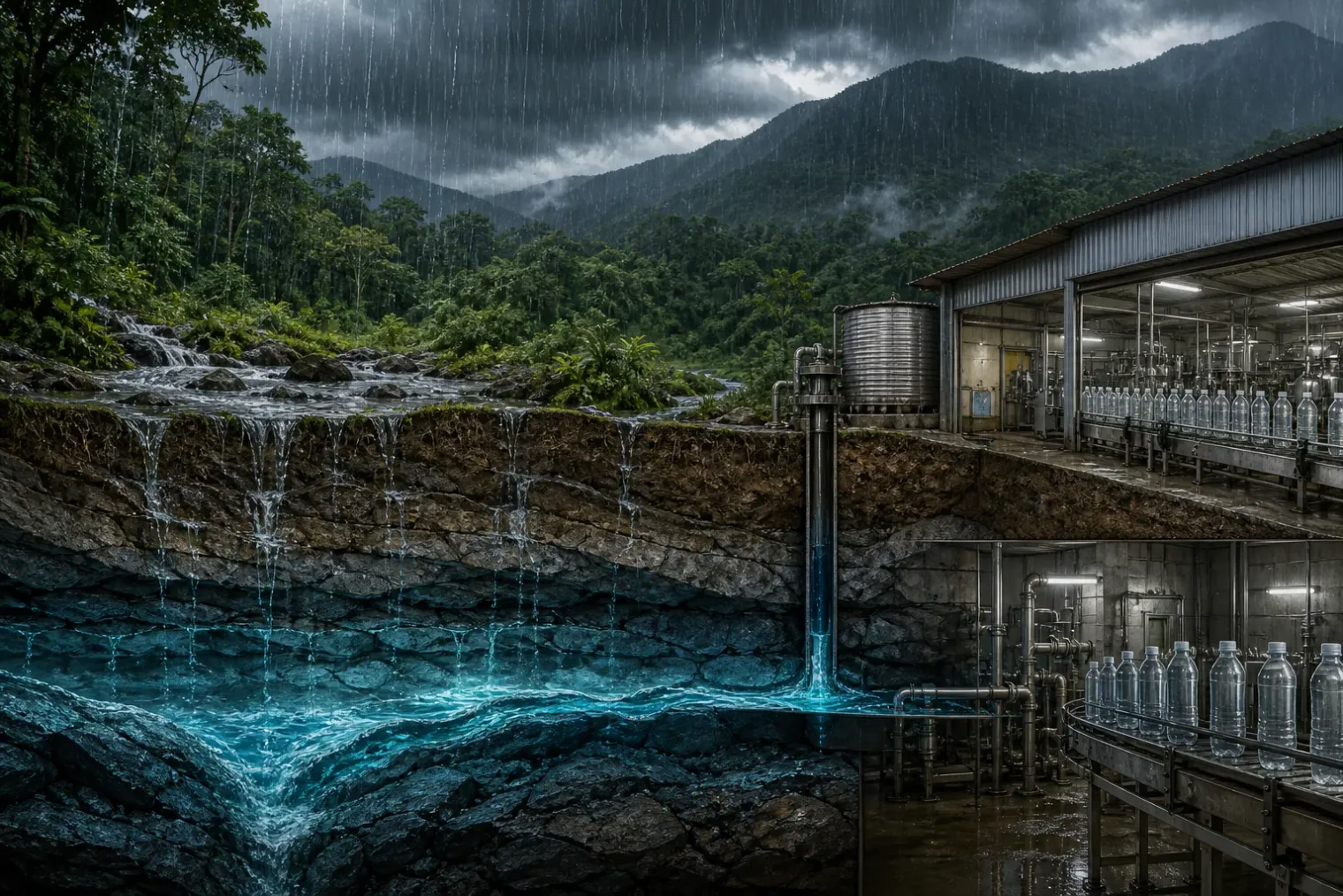
AI-generated editorial cutaway of Taiping rain moving through forest and geology towards a Malaysian water bottling plant
AI-generated editorial visual · not documentary photography

Audited scale · Environmental claims remain attributed

1989First bottling plant

01 · The opening scene

The rain is free. Trust, bottles and distribution are not.

Taiping is known in Malaysia for rain. Water gathers above the Perak town, falls against forested hills and moves through layers of rock beneath the ground. In 1989, a small bottling plant began turning part of that local system into a packaged product.

The idea sounds simple: put water in a bottle and move it to people. In practice, SPRITZER had to build a promise around source protection, testing, factory hygiene, packaging and reliable distribution. The water might begin underground, but trust had to be manufactured every day.

That promise grew into one of Malaysia's most visible bottled-water businesses. The larger it became, the question changed. It was no longer only whether the water was safe and consistent. It was whether a company selling a natural resource could show, in enough public detail, what it took from the ground and what happened to the plastic after the drink was gone.

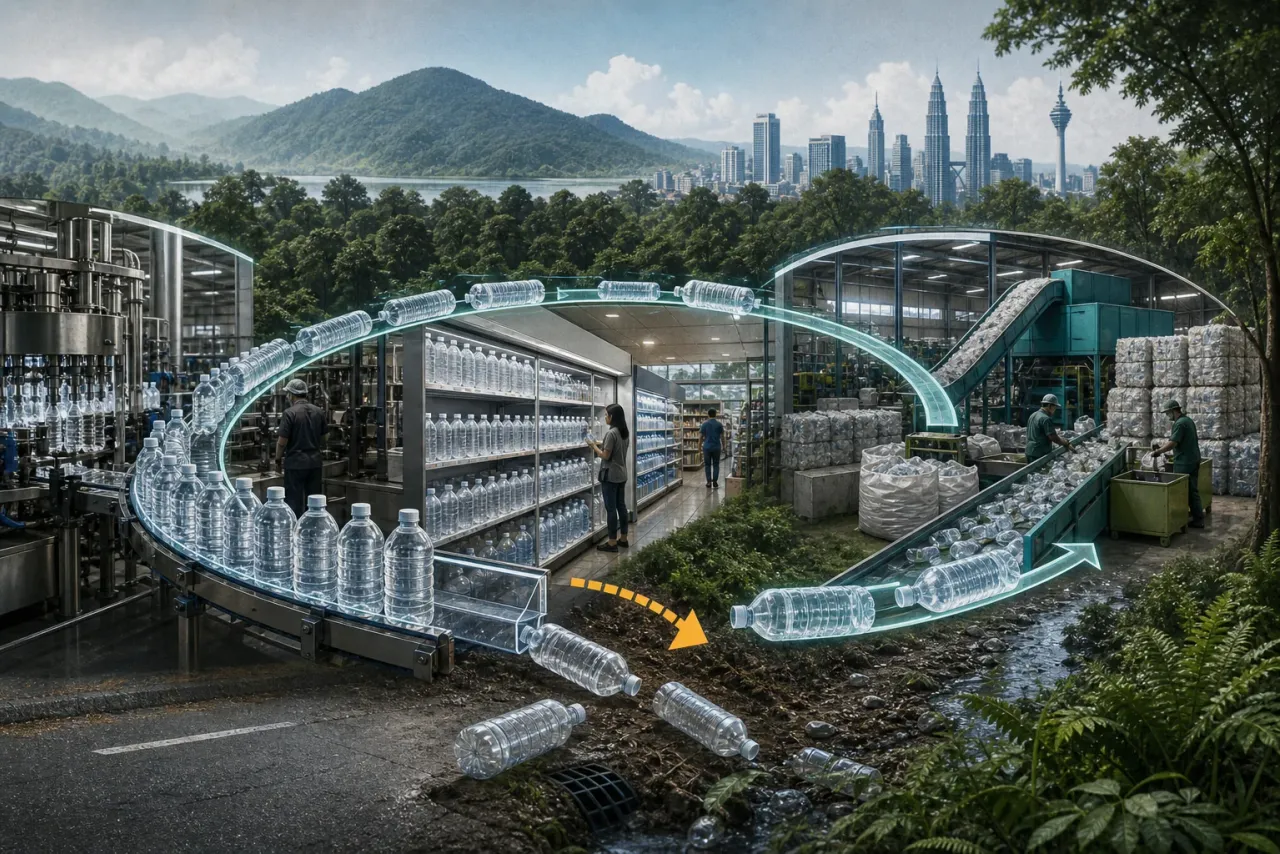
AI-generated editorial interpretation of bottled-water production, use and an incomplete plastic-recycling loop in Malaysia
AI-generated editorial visual · not documentary photography
Started
Taiping, Perak, 1989
Expanded
Air Kuning mineral-water plant, 1994
Listed
Bursa Malaysia, 2000
2025 capacity
1.30 billion litres a year
02

Before the national brand

A Taiping business learned to sell consistency.

SPRITZER traces its first plant to Taiping in 1989. A profile in The Edge's Perak edition identifies businessman Lim Kok Cheong as the founder. The company moved its main mineral-water operation to Air Kuning in 1994, placing the source and factory inside a larger tract near the town.

Consumers were not paying only for water. They were paying for a sealed source they could carry, a stable taste and confidence that each batch had been handled consistently. That meant laboratories, bottling lines, packaging and delivery networks mattered as much to the emerging brand as the rainfall outside.

SPRITZER added products and certifications through the 1990s and listed on Bursa Malaysia in 2000. The listing created a public financial trail that many private consumer brands do not offer. It also made the company answerable to investors while the resource at the centre of the business remained part of a wider landscape.

Water begins as geography. A bottled-water brand begins with repeatable trust.
03

Industrial scale

The small plant became national infrastructure.

SPRITZER's 2025 annual report describes three bottled-water plants and one plastic-packaging plant. It records annual production capacity of 1.30 billion litres, with the group owning 433 acres around its Taiping operations and another 81 acres in Yong Peng, Johor.

Those audited operating disclosures make the scale tangible. The group reported RM656.9 million in 2025 revenue and RM90.8 million in profit after tax on its investor page. Exports remained below 10 percent, indicating that the enterprise was still primarily built around Malaysian demand.

Large capacity is not the same as annual extraction, production or sales, and this story does not treat it that way. It does show how far the company moved from its first plant: source land, factory systems, bottles, warehouses and distribution now form a piece of national consumer infrastructure.

At 1.30 billion litres of annual capacity, stewardship is no longer a side story. It is part of the operating model.
04

What is inside

Mineral water is a relationship between rain and rock.

Natural mineral water is defined by its underground source and dissolved mineral profile, not by a claim that it can transform health. Technical writing about the Taiping site describes rainfall moving through local geological layers before reaching an aquifer, picking up minerals including silica along the way.

SPRITZER owns a large area around the Taiping source and says its extraction is managed to maintain the aquifer's balance. The landholding is documented; the balance claim is the company's. Public-facing materials do not provide enough extraction volumes, recharge estimates, monitoring locations or independent hydrological review for an outside reader to test the full equation.

Quality evidence is stronger when its scope is precise. NSF announced that SPRITZER became the first Malaysian bottled-water brand certified under its beverage-quality programme. The company also says annual SIRIM tests from 2021 through 2026 found no detectable microplastics in tested water. Without full methods and detection thresholds on the public page, that second statement should remain attributed rather than expanded into a universal absence claim.

A protected source is most credible when the public can see both the quality test and the water balance.
05

The bottle after the drink

Recyclable is a design property, not a recovery result.

Plastic made SPRITZER portable and scalable. It also created the company's hardest long-term responsibility. A PET bottle can be recyclable in principle and still be discarded, burned, buried or leaked into the environment if collection and recycling systems do not complete the loop.

SPRITZER reports lighter bottles, recycled content in selected packaging, collection activities and an ambition to become a circular brand by 2030. These measures can reduce material use and create demand for recovered plastic. They do not yet add up, in the public record reviewed for this story, to a group-wide account of bottles placed on the market, collected, recycled and lost.

That gap is not unique to one Malaysian company. It is exactly why SPRITZER matters as a local original. A market leader has the scale to help make recovery visible: publish tonnage, explain boundaries, finance collection and show year by year whether circularity is becoming a measured system rather than an appealing label.

The bottle's environmental story starts—not ends—when a recycling symbol is moulded into it.

06 · Why the world should know it

A Malaysian water story should make the whole cycle visible.

SPRITZER is worth knowing beyond Malaysia because it shows what local industrial capability can build around an elemental product. From Taiping, the company created testing, packaging and distribution systems large enough to place a Perak source in shops and homes across the country.

For an international reader, its story is not a reason to romanticise bottled water. It is a clear case study in the bargain every resource-based consumer brand must make: protect the source, prove the product and take responsibility for the package after purchase.

SPRITZER's audited scale is established. Its sustainability direction is visible. The stronger long-term story will arrive when aquifer withdrawals, recharge assumptions and bottle-recovery outcomes are disclosed with the same clarity as capacity, revenue and profit. That is the standard a Malaysian household name can help set.

07 · The evidence check

What the public record shows.

SPRITZER's 2025 annual report establishes its plants, land, capacity and financial scale. NSF provides independent certification evidence. Aquifer balance, microplastic testing and circularity details are attributed to the company where the public evidence is not sufficient for a broader conclusion.

Audited and independently documented

  1. 01

    SPRITZER's official timeline dates its first Taiping plant to 1989, the Air Kuning move to 1994 and Bursa Malaysia listing to 2000.

  2. 02

    The 2025 annual report records three bottled-water plants, one plastic-packaging plant, 1.30 billion litres of annual capacity and the group's Malaysian landholdings.

  3. 03

    The investor-relations page reports RM656.9 million revenue and RM90.8 million profit after tax for 2025, with exports below 10 percent.

  4. 04

    NSF publicly announced its beverage-quality certification of SPRITZER, providing evidence separate from the company's own website.

Claims and gaps we keep visible

  1. 01

    Source-by-source annual extraction, aquifer recharge estimates, monitoring results and independent hydrological assurance.

  2. 02

    Group-wide plastic placed on the market, recovered, recycled and lost, with clear reporting boundaries and year-on-year comparisons.

  3. 03

    Full sampling methods, laboratory detection thresholds and scope behind public microplastic statements.

  4. 04

    Current domestic market share using a recent, independent and consistently defined dataset.

Follow the story

This is an editorial profile, not a product or health endorsement. Audited operating figures are separated from company sustainability claims. Mineral content should not be interpreted as a medical benefit, and recyclable packaging should not be confused with evidence that every bottle is recovered.

Visit SPRITZER's official website ↗